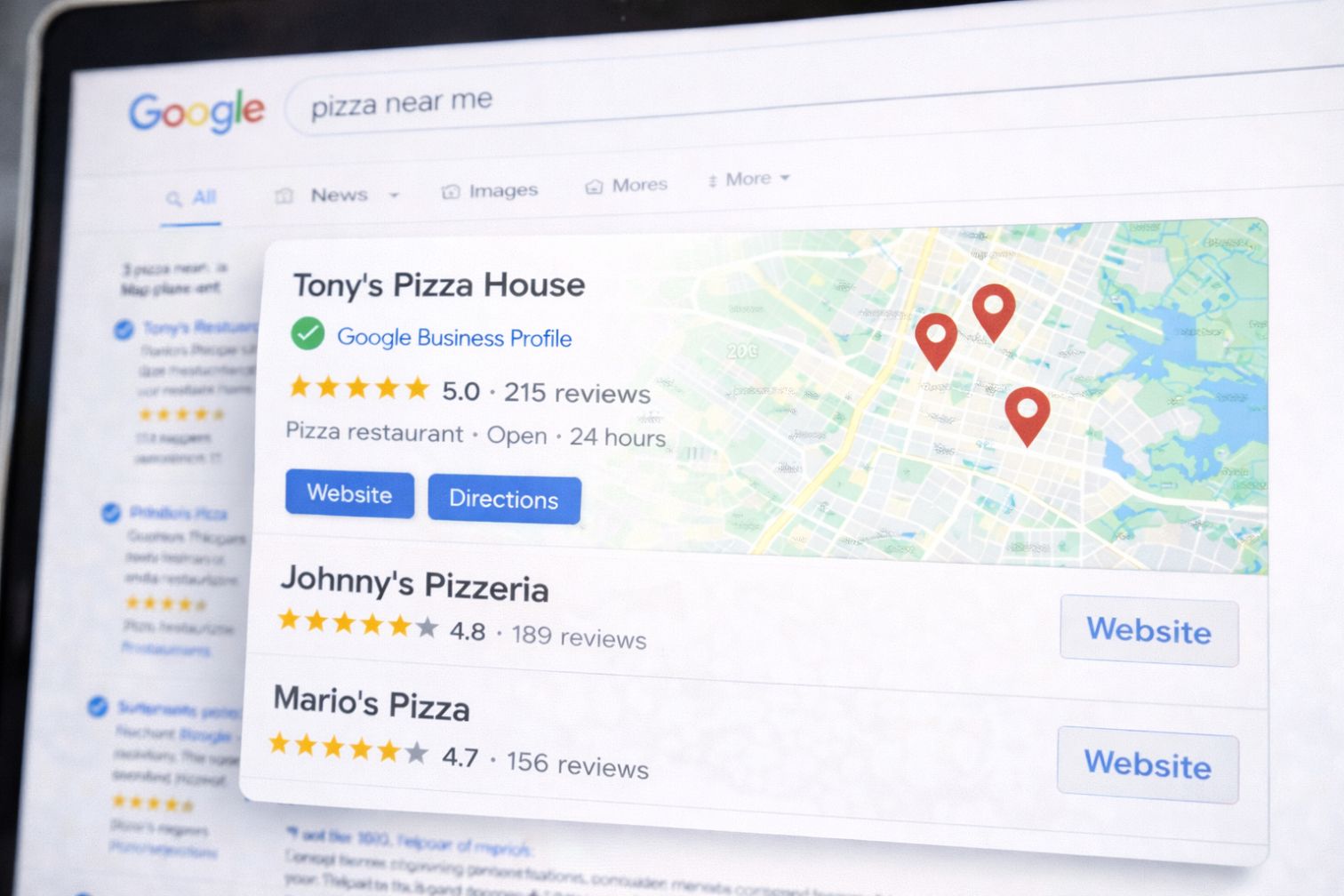
How Diners Search for Restaurants
Restaurant searches are the most frequent local searches on Google. "Restaurants near me" is searched more than any other "near me" query in existence. The decision cycle is measured in minutes, not days. Someone searching "Thai food near me" at 6:30 PM is deciding where to eat right now. The restaurant that shows up first with strong reviews and appetizing photos wins the visit.
This immediacy makes restaurant SEO uniquely powerful. Unlike most local services where a lead takes days or weeks to convert, a restaurant search converts to a customer within the hour. Every position you gain in the map pack translates directly to tables filled tonight.
Third-party platforms like DoorDash, Uber Eats, and Yelp take 15% to 30% commission on every order. A strong Google presence drives customers directly to your website, your phone, or your front door, bypassing commission fees entirely. The difference between paying 30% to a platform and paying 0% through organic search is the difference between barely surviving and thriving.
Craving-Driven
"Pizza near me," "sushi delivery," "best tacos" - immediate decision, highest volume.
Occasion-Based
"Date night restaurants," "birthday dinner," "private dining" - higher spend per visit.
Menu Research
"[Restaurant] menu," "prices," "happy hour specials" - already aware, deciding to commit.
Review-Driven
"Best restaurants in [city]," "top rated [cuisine]" - comparing options, swayed by ratings.
Why Local SEO Is Different for Restaurants
Photos are your most important ranking and conversion factor. No other industry is as photo-dependent as restaurants. Google's algorithm favors listings with frequent, high-quality food photos. Customers scrolling through map results click on the listing with the most appetizing images. A restaurant with 200 photos of beautiful dishes outperforms one with 10 generic interior shots every time.
Cuisine-specific keywords are your competitive edge. "Restaurants near me" is ultra-competitive. "Vietnamese restaurant [city]" or "farm to table dinner [neighborhood]" is far more attainable and attracts customers specifically seeking what you serve. The more specific your cuisine targeting, the higher your conversion rate.
Hours, menus, and attributes drive instant decisions. Google shows restaurant hours, menus, price level, and dining attributes (outdoor seating, happy hour, delivery) directly in search results. Restaurants that fill in every available attribute field in their Google Business Profile appear in more filtered searches and convert more clicks.
The repeat customer cycle is short and frequent. A satisfied restaurant customer returns multiple times per month. One new customer acquired through organic search can represent $2,000 to $5,000+ in annual revenue from repeat visits alone, not counting the friends and family they bring.
High-Intent Keywords for Restaurants
| Keyword | Intent | Conversion Speed |
|---|---|---|
| restaurants near me | High | Within 1 hour |
| [cuisine] restaurant [city] | High | Within 1 hour |
| best restaurants in [city] | High | Within 24 hours |
| [cuisine] food delivery near me | Immediate | Within 30 minutes |
| restaurants open now | Immediate | Within 30 minutes |
| date night restaurants [city] | High | Within 48 hours |
| happy hour near me | High | Same day |
| brunch spots [city] | Medium | Within 48 hours |
| restaurants with outdoor seating | High | Within 1 hour |
| private dining [city] | Medium | Within 1 week, highest spend |
Cuisine-type keywords are your primary opportunity. "Italian restaurant [city]," "Mexican food near me," and "best sushi [neighborhood]" are searched far more than generic "restaurants near me" when totaled across all cuisine variations. Each cuisine keyword you rank for is a distinct customer pipeline.
Occasion and attribute keywords are largely uncontested. "Restaurants with private dining [city]," "pet-friendly restaurants near me," and "late night food [city]" target specific needs that few restaurants actively optimize for. These searches convert at extremely high rates because the customer has a specific requirement.
Google Maps and Map Pack Strategy for Restaurants
For restaurant searches, Google often shows an expanded local pack with photos, price level, cuisine type, and even popular dishes. Your listing needs to shine across every element:
Notice that the winning listing has specific dish mentions in reviews, a clear price indicator, and high volume reviews. In restaurant search, the review snippet often determines which listing gets the tap.
Google Business Profile Optimization Checklist
- Primary category: Choose the most specific match. "Italian restaurant," "Thai restaurant," "Seafood restaurant" instead of just "Restaurant." Specificity wins cuisine searches.
- Secondary categories: Add "Bar," "Catering service," "Delivery restaurant," "Brunch restaurant" as applicable
- Menu: Upload your full menu to Google directly. Not a link to a PDF. Google reads menu text and matches it to food-specific searches. Update seasonally.
- Attributes: Fill in every attribute: outdoor seating, delivery, takeout, dine-in, reservations, happy hour, live music, kid-friendly, wheelchair accessible. Each attribute matches a filtered search.
- Business hours: Include holiday hours and special hours. "Restaurants open now" is a massive search category. Accurate hours prevent lost customers and bad reviews.
- Photos: This is your #1 priority. Upload 20+ high-quality food photos. Shoot in natural light, plate beautifully, and capture signature dishes. Upload 10+ new photos monthly. Restaurants with 100+ photos significantly outperform those with fewer than 20.
- Review solicitation: Train servers to mention reviews during positive interactions. Place subtle review prompts on receipts or table cards. The best approach: the owner or manager personally thanks regulars and asks for a Google review. Mention a specific dish they enjoyed.
- Google Posts: Post 2-3 times weekly with daily specials, new menu items, seasonal dishes, events, and behind-the-scenes kitchen content
- Popular dishes: Google lets you highlight popular items. Select your highest-margin, most photogenic dishes. These appear prominently in your listing.
- Review responses: Respond to every review within 24 hours. Mention the specific dish they enjoyed. Invite them to try something new on their next visit.
On-Page SEO Strategy for Restaurant Websites
Recommended Page Structure
Menu Page (HTML, Not PDF)
A crawlable HTML menu that Google can read and index. Include dish names, descriptions, and prices. PDFs are invisible to search engines. This single change can double organic traffic.
Online Ordering Page
Direct ordering through your website instead of DoorDash or Uber Eats. Keep the 15-30% commission. Make it prominently linked from every page and your Google Business Profile.
Private Events / Catering
"Private dining [city]" and "catering near me" represent your highest-revenue opportunities. A single private event can generate $2,000 to $10,000+. Dedicated pages capture this traffic.
About / Story Page
Your origin story, chef bio, sourcing philosophy, and what makes your restaurant different. This builds the emotional connection that turns first-time visitors into regulars.
Happy Hour / Specials
"Happy hour near me" is searched millions of times monthly. A dedicated page with current specials, hours, and featured drinks captures this high-intent traffic.
Gallery / Ambiance
Professional photos of your dining room, patio, dishes, and bar. Date night and occasion searchers decide based on ambiance. Show them what the experience looks and feels like.
The most critical technical change most restaurants can make: convert your menu from PDF to HTML. A PDF menu is invisible to Google. An HTML menu with dish names, descriptions, and prices can rank for hundreds of food-specific searches. "Best carbonara [city]" or "pad thai delivery [neighborhood]" are searches your menu page can capture.
Add Restaurant and LocalBusiness schema markup. Include Menu schema for your dishes. Make your phone number click-to-call, your address linked to Google Maps, and your online ordering link prominent on every page.
Common SEO Mistakes Restaurants Make
PDF menus. This is the single most common and most damaging mistake. Google cannot read PDF files effectively. An HTML menu with structured dish descriptions generates 5 to 10x more organic traffic than a PDF. This one fix often delivers more impact than every other optimization combined.
No food photos on Google. Restaurants with 100+ photos on Google get 520% more calls than restaurants with fewer than 10 photos. Professional food photography is the highest-ROI investment a restaurant can make for SEO.
Relying entirely on third-party platforms. DoorDash, Yelp, and Uber Eats control the customer relationship and take 15 to 30% of every order. Building your own Google presence and website ordering system keeps that revenue in your pocket.
Missing attributes. "Restaurants with outdoor seating near me" and "pet-friendly restaurants" are filtered searches. If your Google Business Profile does not have the outdoor seating attribute checked, you are invisible to these searches even if you have a beautiful patio.
No private dining or catering pages. These are the highest-revenue events your restaurant can host, and the search competition is minimal. "Private dining [city]" and "restaurant catering near me" have low competition and high conversion rates.
Inconsistent hours. Nothing generates negative reviews faster than a customer who drives to your restaurant based on Google's hours and finds the door locked. Update hours for every holiday, seasonal change, and special closure.
Case Example: Restaurant Results
A mid-range Italian restaurant was spending $2,500/month on DoorDash marketing plus paying 25% commission on delivery orders, generating approximately $8,000/month in delivery revenue (keeping $6,000 after commissions). Their website was a single-page template with a PDF menu. We converted the menu to HTML with 65 dish descriptions, uploaded 150+ professional food photos to Google, built pages for private dining, catering, and happy hour, and launched a review strategy targeting dish-specific mentions. Results over 8 months: Map pack visibility grew from 4 to 38 cuisine and food-specific keywords. Organic website traffic increased from 400 to 3,200 visits per month. Direct online orders through their website grew to $12,000/month at 0% commission. The private dining page generated 8 to 12 event inquiries per month averaging $3,500 each. DoorDash marketing spend was eliminated entirely. Total estimated annual revenue impact from organic search exceeded $200,000.
DIY Action Plan
- Optimize your Google Business Profile using the checklist above. Choose the most specific cuisine category. Fill in every attribute. Upload your menu text directly to Google.
- Convert your PDF menu to HTML. This is your highest-priority action. Every dish name, description, and price should be in crawlable text on your website. This single change unlocks hundreds of food-specific search terms.
- Upload 100+ food photos to Google. Shoot your best dishes in natural light. Capture the ambiance, the bar, the patio. Upload 10 to 15 new photos every month. This alone can increase calls and direction requests by 200% or more.
- Build a private dining and catering page. Include capacity, menu options, pricing ranges, and a contact form. Target "[city] private dining" and "catering near me."
- Set up direct online ordering. Use a platform that integrates with your website (Toast, Square, ChowNow) and keeps commissions at 0% to 5% instead of 15% to 30%.
- Start your review program. Train staff to prompt reviews during positive interactions. Place review reminders on receipts. Have the owner personally thank regulars and ask for a Google review. Target 20+ new reviews per month.
- Create a happy hour / specials page. Update it weekly. "Happy hour near me" is searched millions of times monthly and most restaurants have no dedicated page for it.
Explore More Industries
See how local SEO strategies differ across industries.
FAQs: SEO for Restaurants
How long does restaurant SEO take to show results?
Restaurants often see the fastest results of any industry. Uploading 100+ photos and converting a PDF menu to HTML can increase traffic within 4 to 8 weeks. Map pack improvements for cuisine-specific searches typically develop in 2 to 4 months. Full competitive positioning for "restaurants near me" in crowded markets takes 4 to 8 months.
Is SEO better than DoorDash and Uber Eats for restaurants?
They serve different purposes, but direct Google traffic is dramatically more profitable. A $50 order through DoorDash nets you $35 to $42 after commission. The same $50 order through your own website from a Google search nets you $50. Over a year, switching even 30% of delivery orders to direct channels saves thousands in commission fees.
How important are photos for restaurant SEO?
More important than for any other industry. Google data shows restaurants with 100+ photos receive 520% more calls than those with fewer than 10. Food photos are your #1 conversion tool. Professional food photography pays for itself within the first week of increased traffic.
What does restaurant SEO cost?
Typically $1,000 to $2,500 per month depending on market size and competition. Given the immediate conversion cycle (search to customer within hours) and the savings on delivery platform commissions, most restaurants achieve positive ROI within the first month. View our SEO packages for details.
Should I invest in a professional food photographer?
Absolutely. A single professional shoot ($500 to $1,500) provides months of content for your Google listing, website, social media, and menu. The ROI is immediate: better photos directly increase click-through rates, foot traffic, and online orders. An SEO consulting session can help you build a complete visual content strategy.
Do I really need to convert my PDF menu to HTML?
Yes. This is the single highest-impact change a restaurant can make for SEO. Google cannot effectively index PDF content. An HTML menu with structured descriptions turns your menu page into a ranking asset for hundreds of dish-specific and cuisine-specific searches. Our local SEO services include menu optimization and schema markup.