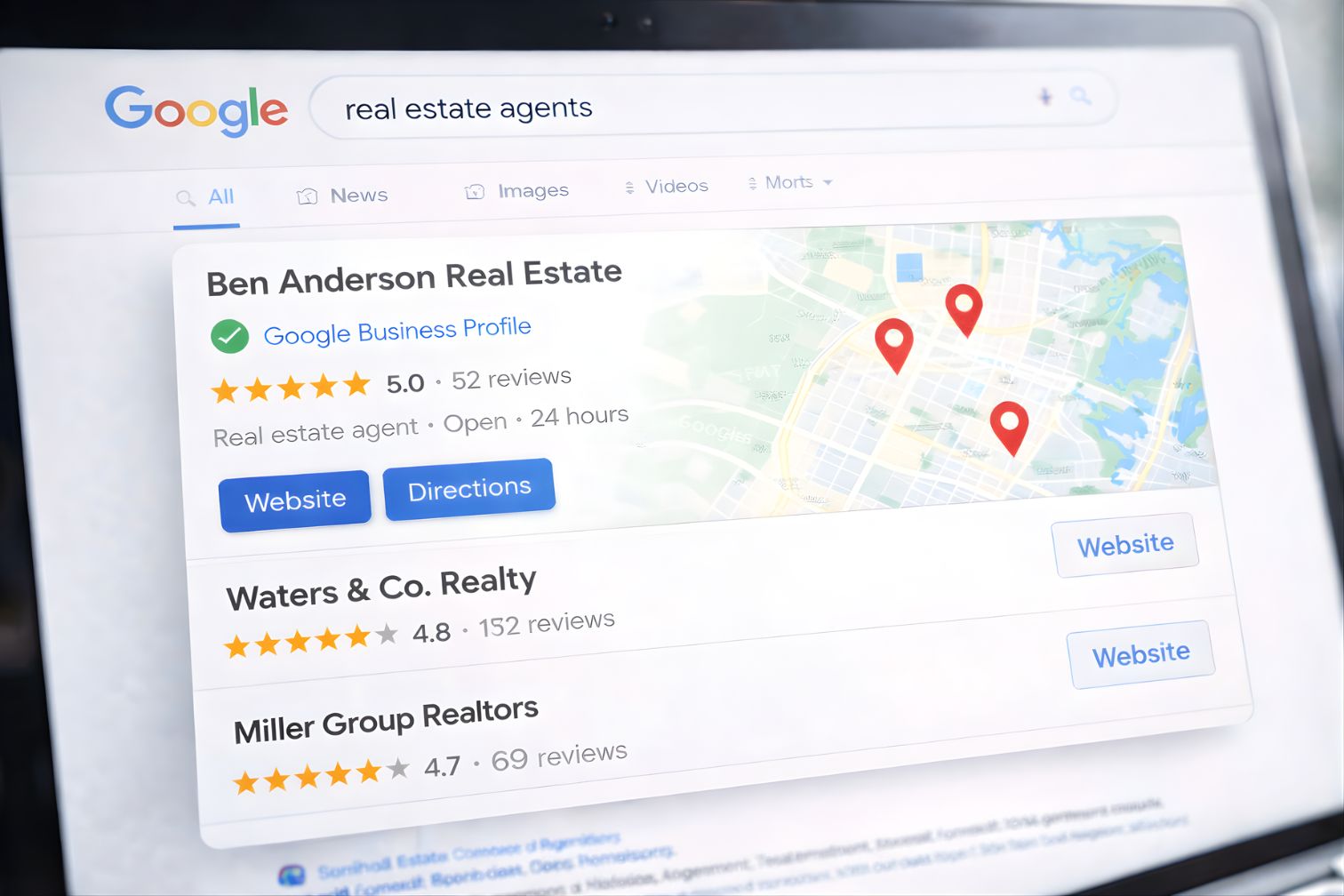
How Buyers and Sellers Search for Real Estate Agents
Real estate search behavior is fundamentally different from other local services. Buyers search by neighborhood, school district, and price range. Sellers search for agents with local expertise and a proven track record. Both paths start on Google long before they ever talk to an agent.
The commission on a single home sale makes real estate one of the highest-value local search verticals. In most markets, one closed deal from organic search covers 6 to 12 months of SEO investment.
Most agents rely on Zillow, Realtor.com, and paid lead sources that charge $20 to $100+ per lead with low close rates. Organic Google traffic is free, pre-qualified, and comes from people actively searching in your specific area.
The agents who rank for neighborhood-level searches build a pipeline that feeds deals year after year without monthly ad budgets.
Research Phase
"Homes for sale in [area]," "best neighborhoods in [city]"
Market Research
"Home values in [neighborhood]," "[city] housing market"
Agent Search
"Real estate agent near me," "best realtor in [city]"
Decision
Reviews, credentials, and local expertise drive the final choice
Why Local SEO Is Different for Real Estate
Hyper-local content is your competitive advantage. No other industry benefits more from neighborhood-level pages. A page about "Living in Oakwood Heights" or "Best Schools in Maplewood" ranks for searches that national portals struggle to compete with.
Personal brand matters as much as business brand. Buyers and sellers choose agents, not brokerages. Your Google Business Profile, personal website, and review presence need to position you as the local expert, not your company.
The sales cycle is long but the payoff is massive. A home buyer may search for months before contacting an agent. The agents who show up consistently throughout that research process earn the trust that converts to signed listing agreements and buyer agency contracts.
Portal competition requires a different strategy. Zillow, Realtor.com, and Redfin dominate "homes for sale" queries. The opportunity for agents is in the long-tail: neighborhood guides, market updates, school district content, and agent-specific searches that portals cannot personalize.
High-Intent Keywords for Real Estate Agents
Real estate keywords split between buyer intent, seller intent, and agent search intent. Here are the terms that generate consultations and signed agreements.
| Keyword | Intent | Value |
|---|---|---|
| real estate agent [city] | High | Direct agent search |
| realtor near me | High | Direct agent search |
| homes for sale in [neighborhood] | High | Active buyer |
| best neighborhoods in [city] | Medium | Research buyer |
| how to sell my house fast | High | Seller lead |
| home value [city/neighborhood] | High | Seller lead |
| first time home buyer [city] | Medium | Buyer lead |
| [neighborhood] homes for sale | High | Active buyer |
| listing agent [city] | High | Seller lead |
| [city] real estate market | Medium | Both buyer and seller |
The biggest opportunity is neighborhood-level content. National portals cannot write authentic, detailed guides about specific communities. You can. Every neighborhood page you create is a keyword cluster that compounds over time.
Seller keywords are underutilized by most agents. "How to sell my house fast" and "home value in [area]" searches represent motivated sellers. These pages can generate listing appointments worth $8,000 to $25,000+ in commission.
Google Maps and Map Pack Strategy for Real Estate
When someone searches "real estate agent near me" or "realtor in [city]," the map pack determines who gets the call. Here is what that looks like:
Individual agent profiles outperform brokerage profiles for personal searches. People search for a person they can trust, not a corporation.
Google Business Profile Optimization Checklist
Your GBP is your personal storefront on Google. Optimize it as an individual agent:
- Primary category: "Real estate agent" - not "Real estate agency" unless you run the brokerage
- Secondary categories: Add "Real estate consultant," "Property management company" if applicable
- Business name: Your personal name only. Do not add "Top Agent" or "Best Realtor" - this violates guidelines
- Service areas: List every city, town, and neighborhood you actively serve
- Business description: Mention neighborhoods you specialize in, buyer and seller services, years of experience, and your brokerage within 750 characters
- Photos: Professional headshot, sold properties, neighborhood photos, team photos. Upload 10+ new photos monthly of listings, closings, and local events.
- Review solicitation: Call past clients personally. Ask how the home is working out for them. Then ask for a Google review. Phone calls convert 3-5x better than texts or emails.
- Google Posts: Post weekly with new listings, sold homes, market updates, and neighborhood highlights
- Review responses: Respond to every review within 24 hours. Mention the neighborhood or transaction type.
On-Page SEO Strategy for Real Estate Websites
The agents who win organic search invest in content that portals cannot replicate: authentic, personal, neighborhood-level content written by someone who actually lives and works in the area.
Recommended Page Structure
Neighborhood Guides
Detailed pages for every neighborhood in your farm area. Schools, dining, lifestyle, home values, housing stock. Your most valuable content asset.
Buyer Resources
First-time buyer guides, mortgage process breakdowns, relocation guides. Captures research-phase buyers months before they contact an agent.
Seller Resources
Home valuation content, "how to sell your house" guides, staging tips. Generates listing appointments from motivated sellers.
Market Reports
Monthly or quarterly market updates with real data. Positions you as the local expert and earns repeat traffic.
About and Credentials
Your story, specialties, certifications, and testimonials. Builds trust once visitors land on your site.
Community Pages
Local events, restaurant guides, "things to do" pages. Attracts relocation searches and builds topical authority.
Each neighborhood page should be 800 to 1,500 words covering schools, walkability, price ranges, housing types, and lifestyle. Include your personal insight. This is what makes your content impossible for a portal to copy.
Add RealEstateAgent and LocalBusiness schema markup. Include FAQ schema on FAQ sections. Make sure your phone number and contact form are prominent on every page.
Common SEO Mistakes Real Estate Agents Make
Relying entirely on IDX for content. Every agent in your market uses the same MLS data feed. IDX pages are duplicate content that Google rarely ranks. Original neighborhood guides and market commentary are what differentiate you.
Using a brokerage profile instead of a personal one. Buyers and sellers search for individual agents. A personal Google Business Profile with your name, your photo, and your reviews outperforms a generic company listing.
No neighborhood-level content. "Homes for sale in [city]" is dominated by portals. "Living in [specific neighborhood]" is wide open. This is the content strategy that actually works for individual agents.
Ignoring seller keywords. Most agents only create buyer-focused content. Seller searches like "home value in [area]" and "how to sell my house fast" generate the most profitable leads: listing appointments.
No review strategy. Agents who rely on voluntary reviews get 2 to 3 per year. Agents who call past clients after closing to check on the home and ask for a review build 20+ per year. Reviews are the most visible trust signal in the map pack.
Generic market pages. A page titled "Market Report" with no location specificity ranks for nothing. Every market update should target a specific city or neighborhood.
Case Example: Real Estate Agent Results
A solo agent in a competitive suburban market was generating most leads through Zillow at $30 to $80 per lead with a 2% close rate. Her website had 4 pages and no neighborhood content. We built 15 neighborhood guides, created monthly market reports for 3 communities, and launched a personal phone-call review strategy. Results over 9 months: Organic website visitors grew from 200 to 2,400 per month. She ranked in the map pack for "realtor in [city]" and 12 neighborhood-level searches. Organic leads replaced $1,800/month in Zillow spend. Three closings directly attributed to organic search generated $26,000 in commission.
DIY Action Plan
- Create or optimize your personal Google Business Profile using the checklist above. Use your name, not your brokerage name.
- Write neighborhood guides for your top 5 farm areas. Cover schools, lifestyle, price ranges, and housing stock. Add your personal perspective. 800+ words each.
- Create a seller-focused page. Target "how to sell my house in [city]" and "home values in [area]." Include your listing process and what sets you apart.
- Start a review program. Call every past client. Check on the home. Ask for a Google review. Target 2+ new reviews per month.
- Publish monthly market updates. Use real data from your MLS. Name specific neighborhoods. This builds authority and earns repeat visitors.
- Build community content. Restaurant guides, events calendars, school comparisons. This content attracts relocation searches and builds topical authority.
- Earn local backlinks. Sponsor community events, join your chamber of commerce, contribute to local publications. Each link strengthens your domain authority.
Explore More Industries
See how local SEO strategies differ across industries.
FAQs: SEO for Real Estate Agents
How long does SEO take for a real estate agent?
Neighborhood guide pages can start ranking within 2 to 4 months for less competitive terms. Map pack placement for "realtor in [city]" typically develops between months 4 and 8. The compounding effect is powerful: each piece of content you add strengthens the whole site.
Can I compete with Zillow and Realtor.com?
Not for "homes for sale in [major city]." But you can dominate neighborhood-level, agent-specific, and market update searches that portals cannot personalize. These are often higher-intent searches with better conversion rates.
Should I have my own website or use my brokerage site?
Your own website, always. Brokerage sites spread authority across dozens of agents. A personal website with your name in the domain builds your brand and your rankings. If you leave the brokerage, you keep everything.
What does real estate SEO cost?
Typically $1,500 to $3,000 per month depending on market size and content volume. A single closed transaction ($8,000+ commission) covers months of investment. See our SEO packages for details.
How many neighborhood pages do I need?
Start with 5 to 10 covering your primary farm area. Each page is a new ranking opportunity. The top-performing agents we work with have 20 to 40 neighborhood and community pages generating consistent traffic. An SEO consulting session can help you prioritize which neighborhoods to target first.
Do Google reviews really matter for agents?
More than almost any other industry. Real estate is a high-trust, high-stakes decision. An agent with 80+ reviews and a 4.9 rating gets chosen over an agent with 5 reviews every time. Review count is also a direct ranking factor in the map pack. Explore our local SEO services to see how we help build review velocity.