How Car Owners Search for Auto Repair
Auto repair search behavior splits into two categories: urgent repairs and planned maintenance. A check engine light triggers an immediate "mechanic near me" search. An upcoming oil change or tire rotation prompts a more deliberate comparison. Both paths start on Google, and both favor shops that appear in the map pack.
The lifetime value of an auto repair customer is what sets this industry apart. A single new customer who trusts your shop returns 2 to 3 times per year for years. That makes the cost of acquiring one new customer through SEO remarkably profitable.
Dealerships dominate brand-specific searches with massive ad budgets. Independent shops win by owning geographic and service-specific searches. "Brake repair near me" and "honest mechanic in [city]" are the searches that build a shop's car count.
Trust is the deciding factor. Car owners have been burned by upsells and unnecessary repairs. A strong Google presence with detailed reviews is the most powerful trust signal available.
Maintenance
Oil changes, tune-ups, fluid flushes. Low ticket, high frequency, builds loyalty.
Repairs
Brakes, suspension, engine work. Higher ticket, urgent search behavior.
Diagnostics
Check engine light, electrical issues. Gateway service that leads to bigger jobs.
Specialty
Transmission, hybrid/EV, European cars. Premium pricing, lower competition.
Why Local SEO Is Different for Auto Repair
Repeat business changes the math. One new customer is not worth one repair ticket. They are worth $1,000+ per year in recurring visits. This means the ROI on acquiring a single organic lead compounds dramatically over time.
Service-specific searches drive the highest-value traffic. "Oil change near me" might be a $50 ticket, but "transmission repair near me" is $1,500 to $4,000. Building pages for each service lets you capture the full spectrum of search intent.
Make-and-model content is a massive untapped opportunity. "Toyota Camry brake repair [city]" and "BMW maintenance schedule" represent car owners looking for a shop that knows their specific vehicle. Most shops completely ignore this keyword cluster.
Trust signals dominate the decision. Car repair has a reputation problem. Reviews that mention honesty, fair pricing, and clear communication convert at dramatically higher rates than generic positive reviews.
High-Intent Keywords for Auto Repair Shops
| Keyword | Intent | Avg. Ticket |
|---|---|---|
| mechanic near me | High | Varies |
| auto repair shop [city] | High | Varies |
| brake repair near me | High | $250 - $600 |
| check engine light [city] | Urgent | $100 - $1,500 |
| transmission repair near me | Urgent | $1,500 - $4,000 |
| oil change near me | Medium | $40 - $80 |
| honest mechanic [city] | High | Trust-driven search |
| [make] repair [city] | High | Varies by repair |
| AC repair car near me | High | $200 - $800 |
| pre-purchase inspection | Medium | $100 - $200 |
Each service needs its own page. "Brake repair" and "transmission repair" attract completely different customers with wildly different budgets. A single "Services" page cannot compete.
Make-and-model keywords are the lowest-competition, highest-trust opportunity. Pages targeting "Honda Civic maintenance [city]" or "Ford F-150 repair specialist" signal expertise that generic competitors lack.
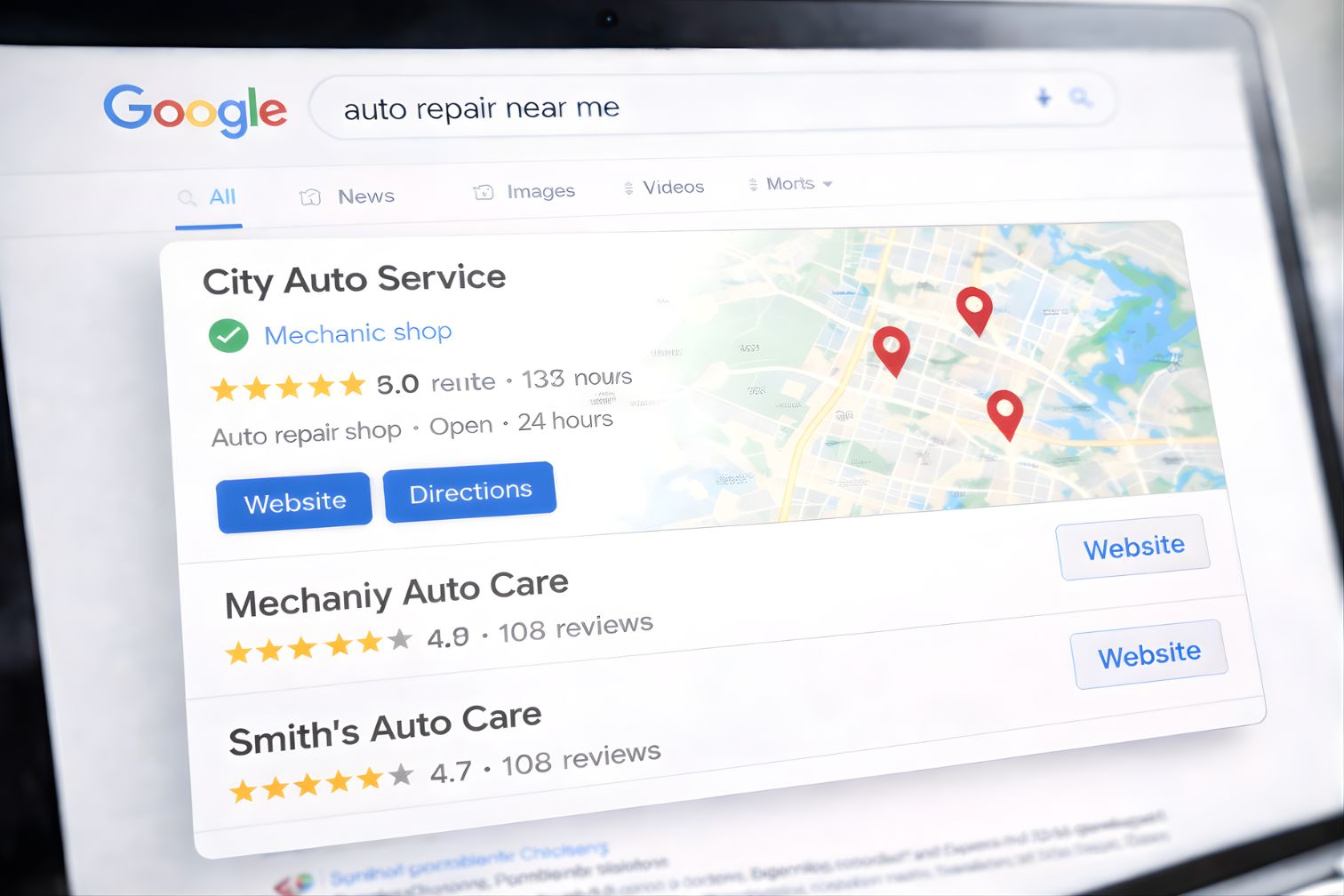
Google Maps and Map Pack Strategy for Auto Repair
Notice the review snippets. In auto repair, what reviews say matters as much as the star count. "Honest" and "fair pricing" in reviews convert browsers into callers.
Google Business Profile Optimization Checklist
- Primary category: "Auto repair shop" - not "Automotive" or "Car dealer"
- Secondary categories: Add "Brake shop," "Oil change service," "Transmission shop," "Auto electrical service" as applicable
- Business hours: Include Saturday hours. Many car owners can only visit on weekends.
- Services list: Add every service with descriptions: brake repair, oil change, engine diagnostics, transmission, AC, electrical, suspension, tire service, inspections
- Business description: Mention your specialties, vehicle types served, certifications (ASE), years in business, and warranty information within 750 characters
- Photos: Clean shop photos, technicians at work, completed jobs, equipment, waiting area. Upload 10+ new photos monthly. Customers want to see a professional, organized facility.
- Review solicitation: Call past customers personally. Ask how the car is running since the repair. Then request a Google review. Phone calls convert 3-5x better than text messages.
- Google Posts: Post weekly with maintenance tips, seasonal advice (winter prep, summer AC checks), and service specials
- Q&A section: Seed common questions: "Do you work on [make]?", "Do you offer warranty?", "What are your diagnostic fees?"
- Review responses: Respond to every review within 24 hours. Mention the specific repair performed.
On-Page SEO Strategy for Auto Repair Websites
Recommended Page Structure
Core Service Pages
Brake repair, oil change, engine diagnostics, transmission, AC repair, electrical, suspension. One page per service with costs and process details.
Make/Model Pages
Toyota, Honda, Ford, BMW, Mercedes repair pages. Signals specialization and captures brand-specific searches with zero competition from generalists.
Symptom Pages
"Car pulling to one side," "grinding noise when braking," "AC blowing warm air." Captures problem-aware searchers before they know the repair name.
Maintenance Guides
Maintenance schedules, fluid change intervals, seasonal prep. Builds authority and captures planned-maintenance searches.
Fleet and Commercial
Fleet maintenance pages target businesses with 5 to 50+ vehicles. Lower competition, recurring contracts, higher lifetime value.
City Landing Pages
Target surrounding cities and communities. Reference local commute patterns, road conditions, and common vehicle issues in each area.
Each page should be 600 to 1,200 words with pricing ranges, repair process details, and expected timelines. Car owners want to know what to expect before they call.
Add AutoRepair and LocalBusiness schema markup. Include your certifications (ASE, manufacturer-specific) prominently. Warranty information on every service page builds trust.
Common SEO Mistakes Auto Repair Shops Make
One "Services" page listing everything. A single page cannot rank for brake repair, transmission work, and oil changes simultaneously. Each service has its own search intent and deserves its own page.
No make-and-model content. "BMW repair [city]" and "Toyota mechanic near me" are high-intent searches with minimal competition. Most independent shops ignore this entirely, handing these leads to dealerships.
Low photo quality. A dirty shop photo destroys trust instantly. Customers equate a clean, organized facility with quality work. Professional photos of your shop, equipment, and team are essential.
Ignoring the review narrative. Star count alone is not enough. Encourage customers to mention specific details: the repair performed, honesty, communication, pricing fairness. These keywords in reviews build relevance and trust simultaneously.
No pricing transparency. Car owners are conditioned to expect hidden costs. Pages that list price ranges ("brake pad replacement: $180 to $350 for most vehicles") build trust that competitors withholding prices cannot match.
Missing fleet/commercial content. A single fleet contract can be worth $20,000 to $50,000+ per year. Most shops have no content targeting business fleet managers.
Case Example: Auto Repair Shop Results
A 6-bay independent shop relied on a coupon mailer ($2,800/month) that attracted price shoppers with low retention. Their website had 3 pages and no service-specific content. We built 14 service pages, 6 make-specific pages (Toyota, Honda, Ford, Chevy, BMW, Mercedes), and launched a personal phone-call review program. Results over 10 months: Map pack visibility grew from 6 to 52 keywords. Organic new customers increased from 8 to 45 per month. The coupon mailer was eliminated entirely. Customer retention from organic leads was 3x higher than coupon customers. Make-specific pages generated 12 new customers per month who specifically wanted "a shop that knows their car."
DIY Action Plan
- Optimize your Google Business Profile using the checklist above. Add every service, upload 20+ shop photos, and set Saturday hours if you are open.
- Build service-specific pages for your top 8 services. Brake repair, oil change, engine diagnostics, transmission, AC, electrical, suspension, and tire service. 600+ words each with pricing ranges.
- Create 3 to 5 make/model pages. Target the most common vehicles in your area. "Toyota repair [city]," "Honda mechanic [city]." Include model-specific maintenance notes.
- Write symptom-based content. "Why is my car making a grinding noise?" and "check engine light on" capture problem-aware searchers before competitors.
- Start your review program. Call past customers, ask how the car is running, and request a Google review. Encourage them to mention the specific repair and their experience. Target 15+ new reviews per month.
- Add pricing transparency. List price ranges on every service page. This builds trust and pre-qualifies callers.
- Earn local backlinks. Sponsor a local sports team, partner with auto parts stores, join your chamber of commerce. ASE and manufacturer certification badges link back to your site.
Explore More Industries
See how local SEO strategies differ across industries.
FAQs: SEO for Auto Repair Shops
How long does SEO take for an auto repair shop?
Service-specific pages for less competitive terms (AC repair, diagnostics) can rank in 2 to 4 months. Map pack placement for "auto repair near me" typically develops between months 4 and 8. Make-and-model pages often rank fastest due to low competition.
Should I show prices on my website?
Yes. Price ranges build trust and pre-qualify leads. Car owners expect transparency. Shops that show pricing get more calls from better customers, while shops that hide prices attract more price shoppers and tire kickers.
How do I compete with dealership service centers?
Dealerships rank for brand-specific terms by default. Your advantage is geographic and trust-based. "Honest mechanic [city]" and "independent BMW shop near me" target customers who specifically want an alternative to the dealer. Build that content.
What does auto repair SEO cost?
Typically $1,500 to $3,000 per month depending on market size. Given the lifetime value of auto repair customers ($1,000+/year in recurring visits), most shops achieve positive ROI within 3 to 4 months. View our SEO packages for details.
Are make-and-model pages really worth creating?
Absolutely. These are the lowest-competition, highest-trust pages you can build. A customer searching "Honda Civic mechanic [city]" wants a shop that knows their car. That search intent converts at extremely high rates. An SEO consulting session can help you prioritize which makes to target first.
How many reviews do I need?
Check the top 3 shops in your map pack. Their review count is your minimum target. In most markets, 200+ reviews with consistent monthly activity is the baseline for strong positioning. Quality matters too: reviews mentioning honesty and specific repairs carry extra weight. Explore our local SEO services to see how we build review velocity.